

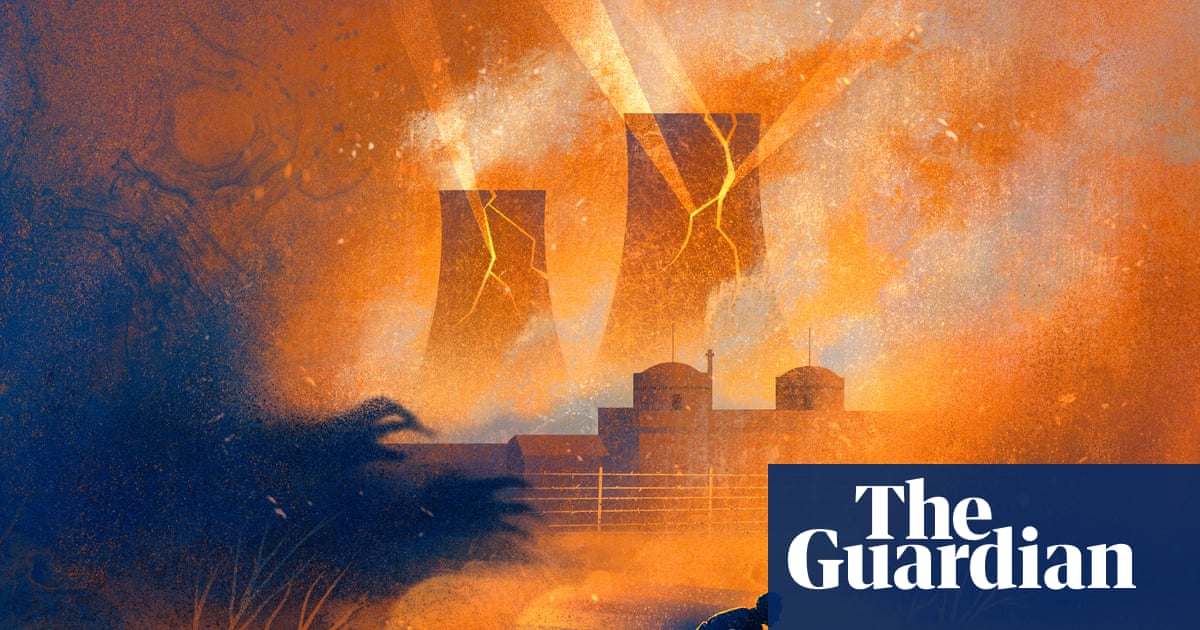
At 21, Rodney Wilkinson was the best fencer in South Africa: national champion in foil and sabre, second in epee. He had toured Europe and Argentina. He had not stood on the Olympic podium, because South Africa was banned. The apartheid state had taken that from him, along with everything else it took from everyone.
One evening in August 1971, Wilkinson stood in the gym at the University of the Witwatersrand in Johannesburg, foil in hand. He was facing his coach Vincent Bonfil, a 25-year-old Englishman who had represented Britain as a reserve at the 1968 Mexico Olympics, and who was now in Johannesburg finishing a master’s thesis in metallurgy. They were working on a technique in which both fencers lunge simultaneously, and the one who reads the other’s move a split second earlier wins the point. They came at each other. Wilkinson’s foil caught the edge of Bonfil’s sleeve. There was a pop.
When a foil snaps, it makes a sound like a lightbulb being smashed, and then there is a blade of steel in the air that nobody is controlling, and it is moving fast. The broken tip went through Bonfil’s chest, beneath his right arm. His mouth filled with blood. He was on the floor in five seconds. Medical students were in the room but there was nothing anyone could do. He died on the way to hospital.
A Johannesburg magistrate ruled it accidental. Bonfil’s mother flew out from England and told Wilkinson she now thought of him as her son. He spent time with the family in England afterwards.
I asked Wilkinson, not long ago, how it had affected him.
“Badly,” he said. And then he stopped talking.
Eleven years after the incident, the same man, who had learned what physics does to a body, was working as a contract engineer at the Koeberg nuclear power station, 19 miles north of Cape Town. He was furious with the regime that had conscripted him, sent him to fight a war in Angola he didn’t believe in, and made his country a pariah. In an act of folly or courage, in December 1982 he walked four bombs into South Africa’s only nuclear power station, weeks before it was due to come online. On 17 December, he pulled the pins, made it out of the control room, had a farewell drink with his colleagues, and then disappeared.
The woman who runs the Hide-Away guest house in Knysna, a small coastal town six hours’ drive from Cape Town and three from Port Elizabeth, claims to know everyone in the area. Her name is Colleen Harding. She is in her 60s, ex-airline industry, and she runs the place with the serene authority of a woman who has appointed herself the intelligence service of the suburb. At breakfast she grills me. What am I doing in Knysna? How long am I staying? Who am I visiting?
I tell her I am there to see a man named Rodney Wilkinson: white, 76, no guest house, no website, no listing anywhere that would help a person like Harding locate him in her system. She has never heard of him.
But the second I say the word Koeberg, her eyes light up. Her nextdoor neighbour worked at the nuclear power station for his entire career. He is in the Old Boys WhatsApp group. Knows someone who was on shift the night the bombs went off. Colleen is already tapping at her desktop with WhatsApp Web open, like a stockbroker executing a 3.59pm trade.
She can connect me to someone from the plant in two seconds flat, but she has never heard of the man who bombed it. It turns out that he lives 20 minutes from her front door. He has been living there for decades. Most people achieve anonymity by being unremarkable. Wilkinson achieved it by being the most wanted saboteur in South African history and then, for more than 40 years, keeping a low profile.
He had help in staying below the radar. The house where he now lives in Knysna belongs to a woman named Matilda Knill, 49, a force of nature, and her husband, Greg Knill, a former game-reserve manager. Matilda first met Wilkinson years ago at a pub. They became friends. When her mother died, Wilkinson started turning up at the house uninvited, with soup and tranquillisers. He cooked for her, her father, her brother. Nobody had asked him to, and nobody asked him to leave. For most of those years Matilda had no idea who Wilkinson was or what he had done. Then a film producer called him. Wilkinson handed Matilda his phone and said: Google “Koeberg”. Her face changed. She moved him in permanently.
Like all white South African men of his generation, Wilkinson was conscripted at 18. He absconded. The South African Defence Force dragged him back, and in 1976 sent him and many others north into Angola in unmarked vehicles. South Africa was fighting a war the regime denied it was fighting. Soldiers were dying and their deaths were being reported in the media as being the result of car accidents. Their parents had to live with the lies.
In Angola, Wilkinson was stationed at a radio relay camp. His unit received coded messages from the field, decoded them, recoded them, forwarded them on. Wilkinson delayed them until they were useless. One came in: “We’ve spotted an unmarked silver helicopter. What should we do?” The answer came back: “Shoot it down.” By the time Wilkinson forwarded the order, the helicopter had been gone half an hour. One time, he drunkenly fell asleep at the wheel of a commandeered troop carrier filled with crates of beer. It turned over. The accident left him with a permanent scar on his forehead.
Wilkinson was, by any reasonable reading, exactly the kind of person you would keep away from sensitive infrastructure. As it turned out, the army was just his rehearsal.
After his army stint, at 29, Wilkinson left Johannesburg and moved to a commune in Cape Town, teaching fencing for a living, which is to say not much of one. A woman named Heather Gray lived in the same commune. Wilkinson, as he told me, “jumped into her bed”. They became inseparable. He smoked a great deal of dagga. (Calling it marijuana makes it sound like a policy problem. Calling it dagga makes it sound like a lifestyle, which, for Wilkinson, it was.)
Years before he met Gray, before Angola, Wilkinson had worked at the Koeberg site as a junior draughtsman, producing technical drawings for the engineers while the nuclear plant was still in the planning stage. Koeberg was the crown jewel of the apartheid state’s energy programme: proof of civilisation, symbol of technological superiority, monument to permanence in a state built on forced labour.
While he was working in the office on site, Wilkinson stole a fat catalogue of drawings – A4, 40mm thick – detailing the layout of the entire facility. He did not steal the plans on his own. There was a Black draughtsman in the office whose job was to control the reference book. “I had a good working relationship with him,” Wilkinson told me, “because I didn’t treat him like an inferior.” So when Wilkinson said: “I’m going to copy this book, but don’t let anybody know,” the man got the message. The next morning, 200 pages were sitting on Wilkinson’s drawing board, wrapped neatly in brown paper. (Wilkinson did not share the man’s name with me, and does not know what happened to him.)
When Wilkinson told Gray about the plans, she told him to keep quiet until they figured out what to do with them. Then she suggested he take them to the African National Congress (ANC). Neither Wilkinson nor Gray had ever met an ANC operative. They had no political training and no contacts. But they decided that’s what they would do: take them to the ANC.
In late 1980, Wilkinson and Gray took the stolen plans and crossed the border into Zimbabwe. The ANC had been banned in South Africa for 20 years. Mandela had been on Robben Island for 16. The leadership operated in exile under Oliver Tambo, the president, who had been running the movement from a desk in Lusaka, the capital of Zambia. The ANC’s armed wing, uMkhonto weSizwe (Spear of the Nation, MK), was scattered across Mozambique, Angola and Zambia. The apartheid government in Pretoria was pursuing ANC operatives wherever it could reach them. Into this tense situation Wilkinson and Gray walked, with no political training and 200 pages of highly sensitive technical drawings.
What Wilkinson and Gray did not know was that someone had already noticed them. In Zimbabwe’s capital, Harare, Jeremy Brickhill, a white Zimbabwean who had deserted the Rhodesian army to join the guerrillas, was a director in the intelligence directorate of Zipra, the armed wing of Zimbabwe’s own liberation movement. He was running a network of agents quietly monitoring the South African exiles flooding into post-independence Zimbabwe. One of his assets, a young woman named Jackie Cahi, reported the arrival of an unusual couple – hippy-ish, no political background, claiming to have nuclear power station plans they wanted to give to the ANC. Cahi housed them. She watched them. She reported back to Brickhill for weeks.
In early 1981, Brickhill engineered a meeting. Cahi threw a party at which Brickhill was introduced as just another guest. The party ran out of beer; Brickhill volunteered to go on a beer run, and made sure Wilkinson – who had a car – drove him. In the car, Brickhill made his pitch. He was an officer in the liberation forces, he said. He knew Wilkinson had something valuable. He wanted to ask some questions about Wilkinson’s background. Wilkinson, drunk, heard “background” as an accusation. “Are you accusing me of being a spy?” He swerved off the road, on to the verge, and pointed the car at a tree. “You don’t believe me, I’m going to kill us both.” The car stopped three inches short of the trunk.
“And then that kind of broke the ice,” Brickhill, who is in his 70s and lives in Harare, told me. “I said something like: ‘Welcome to the struggle, comrade. Now let’s just go and buy a beer.’ But that was the moment I was convinced Rodney was genuine. He was obviously crazy, but he was also genuine.”
Brickhill installed Wilkinson and Gray in a safe house and put them through months of basic training in tradecraft: counter-surveillance, secret communication, resisting interrogation. Some months later, Wilkinson finally handed over the plans – pushing them through Brickhill’s window while the family was out. “It was all this cloak-and-dagger stuff, which we did, and celebrated afterwards,” Gray told the journalist Yunus Carrim years later, in his book Attacking the Heart of Apartheid, an oral history of MK Special Operations. “Hurrah, done our bit. Or so we thought.”
What Wilkinson did not know was that Brickhill’s involvement had been authorised at the highest level. Dumiso Dabengwa, the head of Zipra’s National Security Organisation, had personally signed off on the introduction. The most consequential act of sabotage in South African history was set in motion at the top of Zimbabwean intelligence before the saboteur even knew it was happening.
One Saturday in August 1981, Brickhill asked Wilkinson to come to his house. In the garden was a man who, until then, had existed only in the whispers of exiles: Mac Maharaj. Born in Newcastle, in the province of Natal, to Indian parents, Maharaj had joined the anti-apartheid underground as a young man and was arrested in 1964 for sabotage. He served 12 years on Robben Island alongside Mandela. On his release in 1976, he smuggled out the manuscript of Mandela’s autobiography, transcribed in microscopic handwriting and hidden inside the covers of a notebook. When I sat down with him over video link this year, Maharaj was 90 and still formidable. I asked him his secret for staying sharp. “Go to prison,” he said.
In their first meeting, Maharaj noticed the scar on Wilkinson’s forehead and drew out the whole story. “All that background,” Maharaj told me, “suggested that here was a person from a privileged community, but quite a person to do things his own way, not to be bound by rules created by the system.” He continued: “He was a dagga smoker, a hippy, a commune-living guy. And I can see he is one loose cannon. But this is the guy. He has left no trail. He has got no political background, so you can send him back.”
Maharaj made a specific recommendation to Wilkinson’s ANC handlers: Heather Gray was a stabilising influence. They should treat her as Wilkinson’s operational partner. Gray’s political awareness had been stirred at an early age, through her sister Diana, who was involved in the anti-Vietnam war movement and the 1968 student revolts. Gray was a speech therapy student at the University of Cape Town and was anti-nuclear before she ever met Wilkinson. Within the ANC, Maharaj told me, the assessment was that of the two, she was the stronger. But Maharaj was also struck by the fact that, beneath the dagga and the dishevelment, Wilkinson was the kind of person who had reached the highest level in fencing. “Not a sport you indulge in,” he told me. “It is not just reflexes. There is a mental strength that goes with it.”
In the months that followed, the drawings that Wilkinson had taken from Koeberg went up the chain to Joe Slovo, head of MK’s Special Operations, the strategic sabotage unit that reported directly to Tambo. Slovo had them authenticated by nuclear scientists in the Soviet Union and Britain. They were genuine.
The ANC had been trying to figure out how to target Koeberg for years. A bomb inside the plant, on the reactor heads, in the control rooms, would be the most symbolically devastating strike in the history of the struggle. Now they were in contact with a man who had once worked inside Koeberg, who knew its layout, who could plausibly walk back in. They asked Wilkinson to undertake the mission himself. To plant the bombs.
The field commander assigned to the operation was Aboobaker Ismail, code name Rashid: a 27-year-old science graduate from Lenasia, the Indian township south-west of Johannesburg, who was quiet, methodical and obsessive about detail. The value of an operative who could re-enter the plant, with a face that looked like it belonged there, was greater than any unit cutting through a fence from outside. Why send a unit when you already had a ghost?
Wilkinson said he would think about it. “Not whether it was the right thing,” he told me, sitting in a chair in Knysna 43 years later. “But whether I had any chance, or was prepared to take the chance. By that time I was a father.” Wilkinson had been raising Heather’s daughter, Kyla, from a previous relationship, as his own. “So it was quite a big decision.”
I asked him: did you think you would get caught? Get killed?
“Get killed, both.”
“You thought it was the last day of your life?”
“No. I thought it was a risk. Serious risk to life.”
He said it the way you would say it rained on Tuesday. By the time he and Gray drove from Zimbabwe back into South Africa in June 1982, he had said yes.
Their friends and family in Cape Town had no reason to think the 18 months in Zimbabwe had been anything but an adventure. Wilkinson and Gray said they were coming home because they could not get money out of South Africa to support Kyla. Nobody outside the ANC operatives who had recruited him knew the truth.
On 19 July 1982, Wilkinson was issued a Koeberg gate pass for his yellow Renault 5. He had talked his way into a short-term engineering contract that would run until mid-December. The plant was roughly six months from going live, a date the regime trumpeted in newspapers. The window was closing from two directions: the reactor going online and Wilkinson’s contract running out were converging on the same deadline.
Over the next five months, Wilkinson met Rashid half a dozen times in Swaziland, a small kingdom tucked between Mozambique and South Africa where neither side’s intelligence services could comfortably operate. Wilkinson never made direct contact with Rashid from inside South Africa. When he needed to reach Rashid in Mozambique, he sent a telegram disguised as a horse racing bet. They had assigned numbers to each location inside the plant, so a message about backing “No 3”, say, was really a message about a reactor. They went through everything: targets, escape routes, how Wilkinson and Gray were holding up under the strain.
In an interview with Carrim, Gray later described the operational secrecy: “One weekend Rod told everybody that we’d gone away, and I was literally alone in that house for the whole weekend, creeping around with the curtains closed and the lights off. That’s how careful we were.”
Wilkinson was terrified. “Often, I had serious doubts and a paralysing weakness and fear,” he told me. “I started to hallucinate, almost suspecting I was being followed.”
Gray was the only person he could talk to. She had one rule: “I would never ever be able to live with a radioactive accident,” she told him. The operation had to happen before the uranium fuel was loaded into the reactors, and on a weekend, in the early hours, to minimise the risk of anyone being hurt.
At their final meeting, the last weekend of November 1982, Rashid handed Wilkinson a map showing where his operatives had hidden the four limpet mines: a dead letter box in the Karoo, the semi-desert that stretches across the South African interior. Wilkinson memorised the location, then ate the map. He and Gray drove out before dawn, located the four devices, packed them into wine boxes, and brought them home. They were afraid there would be a checkpoint on the way back. There wasn’t. Wilkinson assembled the bombs and reburied them, all four together, at Melkbos, the beach south of Koeberg, and marked the cache with a strip of yellow plastic.
A few weeks before the operation, Gray contacted Brickhill on the secure channel they had set up in Harare. She was frightened. Wilkinson was drinking heavily, behaving erratically, talking loosely. Brickhill asked the ANC whether backup was available. There was none. “The only backup he had was Heather,” Maharaj told me. He advised Gray to head abroad. There was no point staying to be captured if Wilkinson was no longer listening to her. She went back to Zimbabwe and sat with Brickhill, waiting.
A limpet mine is about the size of a whisky bottle. It has a magnetic plate on one side so it sticks to whatever metal you attach it to. Inside the casing is a timed fuse: when you pull the pin, a mechanism begins a slow countdown to detonation. There is no way to stop it once it starts. If the mechanism fails, it fails quickly. Wilkinson had been given the longest fuses available: 24 hours. Pull the pin on Friday afternoon, and by Saturday afternoon, if everything works, the mine detonates. If something goes wrong, it goes wrong while you’re still in the building.
Rashid had opened up the Soviet-supplied devices and packed thermite into the casings, alongside the existing explosive. Thermite is an incendiary mixture of aluminium powder and iron oxide that burns at about 2,200C, hot enough to cut through steel. Once thermite ignites, water makes it burn hotter. It would turn each mine from a bomb that exploded into a bomb that exploded and then burned. Fire, unlike a blast, travels through cabling. It spreads.
The layout of Koeberg played in Wilkinson’s favour. Two reactors, each in its own containment building, with two control rooms wired together through the same cabling. Rashid’s logic was straightforward: hit just one reactor, and the regime could use parts from the other and bring it back online. Hit everything, and the damage would cascade. Wilkinson was instructed to place one mine on each of the two reactor heads, and to tuck one mine into the cabling under each of the two control rooms.
The problem was that three layers of security stood between Wilkinson and Reactor 1. First, a vehicle search at the gate. Then a pedestrian checkpoint with a guard and a dog. Finally, a changing room before the clean area of the nuclear island, where everyone had to strip and put on paper overalls. For the other three targets, he only needed to clear the first two.
For Reactor 1, he had another challenge. A tunnel connected the unclean area to the clean zone, with two pipes running along the wall. A plywood panel blocked dust from entering the clean zone, but it had been cut to let the pipes through, and between the pipes was a gap just wide enough for a limpet mine. The device couldn’t come with him through the changing room, so he would have to pass it through the gap, walk through the changing room, and collect it on the other side.
Wilkinson’s office sat between the car entrance and the plant. He drove in with a limpet hidden in a void behind the dashboard panel of the Renault on Saturday 11 December, and again on Monday 13 and Tuesday 14. On Wednesday 15 he lost his nerve and left the fourth at home. On Thursday 16, the Day of the Vow – an Afrikaner nationalist holiday, skeleton crew – he brought the last device in. On every occasion, in the parking lot, he transferred the limpet from the dashboard cavity to a shoulder bag. He locked the bag in his steel desk drawer.
Late morning, the guards at the pedestrian gate would slip into the last drowsy hour before their noon shift change. That was the window. Wilkinson would pull the limpet from his drawer, slide it into his belt under his shirt, walk down the corridor, and walk through the checkpoint with his hands in his pockets. The dog never moved. The guard never looked twice.
Friday 17 December 1982. His last day of work. Between 10.30 and 11.30 in the morning, Wilkinson walked the four limpets, one by one, from his desk drawer to their intended final positions: one on each of the two reactor heads, one tucked into the cabling under each of the two control rooms. He cleared the final security check, collected the device he had passed through the panel earlier in the week, and walked toward the entrance. A guard was watching him. The reactor was about to go online. There was no legitimate reason for anyone to be in there. The guard’s stare went on too long. Wilkinson froze. He turned around. He told the guard he would be back in half an hour. He walked out. He never went back. He placed that device in Reactor 2 instead.
Nobody else stopped him. Nobody asked. He went back to his desk and waited for lunch.
Pulling the pins was the afternoon’s work. You pull a pin on a 24-hour limpet fuse and one of two things happens. Either a lead-shear mechanism begins a slow, silent countdown inside the casing – no ticking, no click, no outward sign that anything has changed – or the mechanism fails and the mine detonates in your hand. There is no middle outcome. There is no way to test which one you are getting until you pull.
He did the first one. He waited. He was still alive.
He walked to the second. Pulled. Alive.
One. Two. Three. Four. Four times he stood next to a live explosive with thermite packed into the casing and pulled the pin and turned his back on it and walked out of the room, and four times the mechanism held.
Close to 5pm, he had farewell drinks with colleagues. He had told them he was going to see his girlfriend in London. (That part was true: England was his final destination, though Gray was actually in Zimbabwe at this point.) Everyone wished Wilkinson well. He stood there with a glass in his hand, saying goodbye to colleagues who were standing on top of four ticking bombs, and none of them had the faintest idea, because the bomber looked like them and sounded like them and played squash with their boss.
Wilkinson got on his bicycle and rode out of Koeberg. His friend Shauna Westcott drove him to Cape Town international airport, bicycle in the back of the car. He handed her his work boots and overalls. The boots had left tracks in the dust near the devices. He asked her to get rid of them. She didn’t ask questions.
He took a flight to Johannesburg airport where his sister Cathy came to meet him. He got in her car. She looked at him and started crying. Neither of them moved.
“What have you done?”
“I can’t really tell you.”
“Did you kill anybody?”
“I don’t think so.”
“Is it political or criminal?”
“It’s political.”
That calmed her down a little. She put the car in gear and they headed for the Swaziland border. Wilkinson couldn’t find the crossing. A herd boy eventually pointed him toward a run-down bit of barbed-wire fencing. That was the international border between apartheid South Africa and Swaziland.
On the other side, Wilkinson found a stream and lay down in it with all his clothes on. People passing were laughing at the white man in the water, and he was laughing back. Then the sky opened: a hailstorm so violent he had to crawl under a tree. He felt liberated.
The next day, Saturday 18 December, he took a bus to Manzini, Swaziland’s second-largest city and its commercial hub, then carried on to the Wimpy Bar in Mbabane, the capital, where Rashid had told him someone would come for him. He was to check on the hour, every hour. He did not know who would arrive. He did not know what they’d look like.
Nobody came. “Boy, did I wait. I was pissed off,” Wilkinson told me.
So he tried the backup: a phone number for Rashid in Maputo, Mozambique. He stood in the queue for the telephone booth. Twenty minutes. When he arrived at the front, he dialled Rashid’s number and got what sounded like an engaged tone. He hung up and went to the back of the queue. Twenty more minutes. Dialled. Engaged. Hung up. Back of the queue.
What Wilkinson did not know, and would only figure out much later, was that the South African ringtone sounded identical to the Mozambican engaged signal. Every time he thought the line was busy, it had in fact been ringing. He’d been hanging up on his own commander.
The third time he reached the front of the queue, more than an hour in, he lost patience. He pretended the call had gone through and began a conversation with the engaged signal. He nodded. He murmured. He said uh-huh. Then, suddenly, to Wilkinson’s surprise, Rashid picked up.
Wilkinson kept his voice conversational. He had three things to communicate: he needed a way to get from Mbabane to Maputo; the fence between the two countries was too high to jump, and he had no entry stamp in his passport because he had come in through a farm fence. He assumed the South Africans were listening to every call crossing the Swaziland lines, but he managed to get his points across in code. Rashid arranged it all.
The following evening, Sunday 19 December, Wilkinson took the 5pm flight from Mbabane to Maputo. Rashid met him on the other side with whisky and Soviet fish. It was here, in Maputo, that Wilkinson learned what had happened. All four limpets had detonated. Nobody had been hurt. Wilkinson drank and laughed. He was alive.
The first mine had detonated at 3.23pm the previous afternoon, Saturday 18 December. The second at 8.40pm. The third at 11.24pm. The fourth at 2.53am on Sunday morning. Four explosions across roughly 12 hours, at an active construction and commissioning site rather than a live reactor – every section of the plant all but empty between blasts, nobody hurt.
In Harare, Brickhill and Gray were holed up with a small group of comrades in the house of Howard Barrell, a journalist who was himself quietly working with ANC intelligence, drinking whisky and listening to the BBC World Service. Barrell knew nothing of this particular operation. When the first report came through in the early hours of Sunday 19 December, Brickhill asked him – without telling him why – to phone his newsroom contacts and find out what he could. The next morning, the story made the front page of the New York Times, under the headline “Bombs damage atom plant site in South Africa”.
A few days later, in Maputo, Wilkinson was taken to meet Oliver Tambo, the man who had kept the anti-apartheid movement alive from a desk in Lusaka while Mandela was in prison. Tambo looked at Wilkinson with something like surprise. Then he hugged him and they both cried. Tears of joy, Wilkinson said.
The operation had been given a code name. Joe Slovo and Rashid had called it Operation Mac, after Maharaj, whose role in recruiting Wilkinson had been central. Maharaj himself only learned about the name months later, in a Lusaka corridor, when Tambo and Slovo told him in passing. It was, in other words, a thank you and a prank.
The damage was enormous: R500m, roughly half a billion dollars in 1982, when the dollar and the rand traded at par. The project was pushed back 18 months. A manager at Eskom, the state-owned utility that ran the plant, publicly blamed the Baader-Meinhof gang, the West German far-left militants. Others suspected an inside job at Framatome, the French company that had built the plant. The identity of the perpetrators remained a mystery for 13 years. Then on 15 December 1995, David Beresford wrote a front page story for the Mail & Guardian – South Africa’s newspaper of record – under the headline “How we blew up Koeberg (and escaped on a bicycle)”, identifying Wilkinson by name.
For Maharaj, what mattered was that, alongside the ANC’s 1980 attack on the Sasol fuel refineries, Koeberg had demonstrated the capacity of the anti-apartheid movement to hit the regime’s strategic infrastructure. “There was no target out of reach for us,” he told me. “Not because of our capacity. Because of the nature of the system. The overwhelming majority of the Black people who were the oppressed, even though there would be collaborators, by their very instincts would be opposed to living under the humiliation that apartheid imposed on them. And in the white community there would be young people beginning to question. We were not alone.”
Wilkinson had assumed that his former colleagues would pin the bombing on him within a day. After all, he had openly criticised nuclear power at the whites-only bar on the construction site. But they never even considered him. He worked for the civil contractors; the operators who ran the control rooms would never have crossed his path. Dave Thomas, who had started in the control room at Koeberg that year, told me: “He certainly wasn’t on our radar as a person at all.” The most paranoid security apparatus on the continent had built, without intending to, the perfect cover for the man who was going to blow it up.
The ANC sent Wilkinson to England. Gray joined him there, and they married in December 1983. They settled in Woodbridge, Suffolk, pulling pints at the Mariner’s Arms while he waited for a work permit.
Maharaj’s advice was to take the £1,500 bonus the ANC offered its operatives, and vanish. Wilkinson made a counter offer: he would take £150 and keep working for them. Maharaj said this was a mistake, but Wilkinson did not want to be a ghost. Wilkinson’s next idea was a tourist truck with a stash of weapons hidden beneath the passenger seats. Unwitting backpackers crossing into South Africa would provide the cover. The ANC, through a London-based front company called Africa Hinterland, run by Mannie Brown, an ANC exile and veteran communist, funded the project, owned it, and recruited drivers from the British and Dutch communist parties. Wilkinson designed the truck, a Bedford, and helped build it at a workshop outside Ipswich in 1986. He never went on a single trip. Africa Hinterland crossed the border about 40 times between 1986 and 1993 and was never compromised.
Wilkinson and Gray came back to South Africa in April 1991, a year after Mandela’s release, and settled in Knysna, the coastal town where Wilkinson would eventually live out his later years in obscurity. Wilkinson was still an ANC operative. With Mandela free and the movement legal for the first time in three decades, the ANC was opening offices across the country. In Knysna, Wilkinson was asked to run both the local ANC office and a Communist party office, the kind of dual posting handed to trusted former operatives.
Later that year, Raymond Mhlaba, who had spent 25 years in prison alongside Mandela and had been released in October 1989, was due to address a political rally in town. The ANC printed a pamphlet advertising the rally and listed the Wilkinsons’ home phone number as the contact. The phone was in Gray’s name. Soon after, a note appeared under the door: “Hit No 33, Heather Wilkinson.” It was signed by a rightwing murder squad. Bikers began driving past the house with shotguns across their backs. The couple’s two small daughters, Jessica and Amy, were inside, with only a wooden wall for protection. Gray went to her father, a man Wilkinson describes without bitterness as “billionaire daddy”. He said: “Come home.” Wilkinson wasn’t invited.
It was the sensible decision. Wilkinson knew it. He just wasn’t part of it.
Today, he is 76. His lungs are scarred from tuberculosis. Somewhere in the house where he lives on Hope Street there is a pennywhistle I sent him from a shop in Johannesburg, because I couldn’t find one in Knysna. Wilkinson learned to play as a child. The instrument belonged to the townships. In the 1950s a Black musician called Spokes Mashiyane, busking on the same Johannesburg streets where Wilkinson grew up, turned kwela street music into the biggest-selling sound of its era. It was music for the people apartheid was built to suppress. Wilkinson bombed a nuclear power station for that movement. Now, he plays kwela through scarred lungs, in a town that still doesn’t know who he is.
Matilda Knill told him, when he was sick: “You can’t die. There’s a lot of shit you’ve got to sort out.”
“OK,” Wilkinson said. “What must I do?”
Listen to our podcasts here and sign up to the long read weekly email here.
