

They call this land the Laue. In the late 1800s, part of these 200 acres of grassland inside the Quapaw Nation were allotted to tribal citizen Charley Quapaw Blackhawk. After forcing dozens of tribes into Indian territory before the civil war, the US government then parceled out reservations and property to individual members. It was part of the government’s attempt to “civilize” Native Americans by turning them into private, not communal, landholders and yeoman farmers in the model of Thomas Jefferson’s ideal citizen.
Yet, for the last century, little grew on the Laue. Half of it was buried beneath towering mounds of toxic rock known as chat piles. The waste rock, laced with chemicals, was left after miners extracted millions of tons of lead and zinc from the Tri-State Mining District, where the valuable ores stretched across Kansas, Missouri and Oklahoma between 1891 and the 1970s. By 1983, the Environmental Protection Agency (EPA) had designated 40 sq miles that include nearly all the Quapaw Nation as the Tar Creek Superfund site, joining the EPA’s list of the most contaminated places in the country. Informally called a “megasite”, Tar Creek remains one of the largest and most complex environmental disasters in the country.
After years of cleanup, the Laue has been cleared of chat. The ground has been restored and tested. The soil is healthy again. Like hundreds of acres across the Quapaw Nation, it has returned to agriculture. And the Quapaw, a community with more than 6,000 members, have led this revitalization themselves as the first and only tribal nation in the country to manage and carry out a Superfund cleanup. By cleaning contaminated ground – a slow process that began 40 years ago and will likely continue for decades – the tribe can expand its farming efforts and food production on its own terms.
A new sense of identity and independence
Last spring, the Laue, a common surname in the area, was covered in green fields of oats 2ft high. The Quapaw’s agriculture office uses the pasture to rotate a herd of about 400 cattle.
Larry Kropp, a rancher and Quapaw citizen in his late 70s, grew up down the road from the Laue. As a boy, he was warned to avoid open mine shafts. In winter, he sledded down the chat piles that covered the fields. It makes him happy to see the land finally cleared and used to feed cattle. He can also imagine what this place was like when the Quapaw arrived.
“They talk about the waves of grass and compare them to the ocean. I would like to see that one of these days,” he said.
Agriculture is the main business in this rural corner of north-east Oklahoma. Cattle and row crops – corn and soybeans – are generating more revenue. The Quapaw expect the nation’s agricultural division to turn a profit, as they do with casinos, resorts and convenience stores.
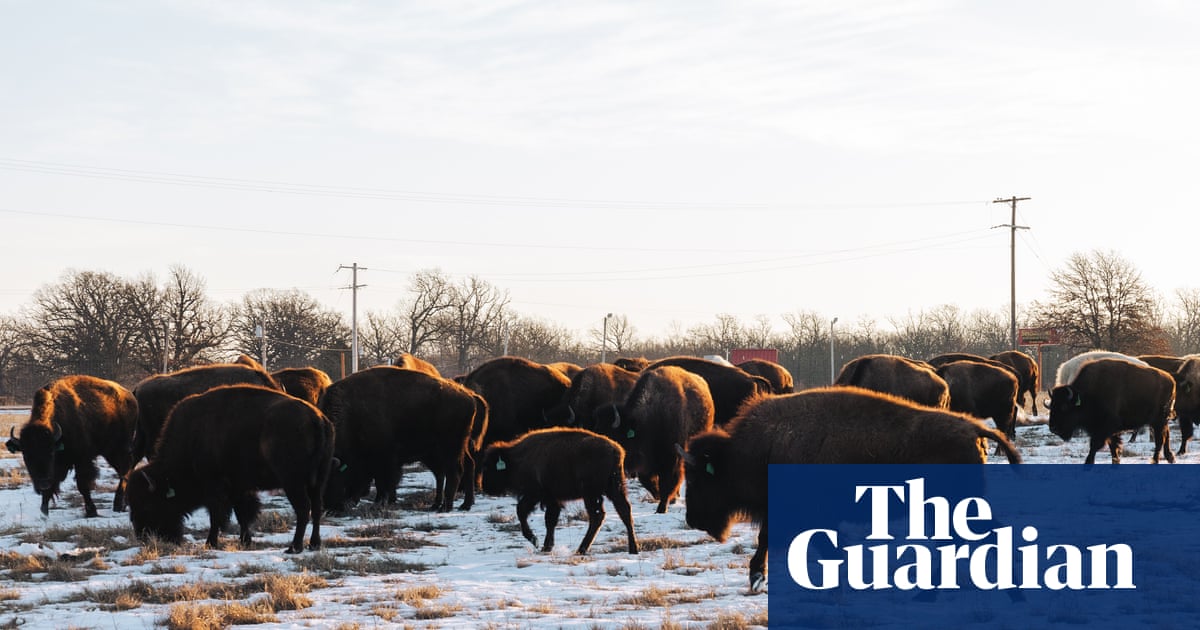
The bison herd surrounding the tribe’s Downstream Casino Resort, however, is both sustenance and symbol. The greenhouses and gardens of the tribe’s food sovereignty division raise tomatoes, cucumbers and also traditional medicines. The Quapaw meat-processing plant, the first opened by a tribe, is a business that also ensures a steady supply of protein to the tribe.
For the Quapaw, agriculture means identity and independence. In the mid-1600s, one of the first Europeans to encounter the Quapaw, who were then living in what is now eastern Arkansas, reported miles of fields planted with beans, plums, pumpkins, sunflowers, peaches and grapes. Corn was the tribe’s staple crop. Men hunted, women tended crops and both played roles in tribal politics, as was typical for tribes in the Mississippi Valley. As historian Kathleen DuVal noted in her book The Native Ground, that gendered division of labor vexed the Anglo-American settlers, who were unable to get over their “agrarian sexism” and notion that farming and leadership were men’s business.
“To be truly civilized,” DuVal writes, “Quapaw men would have to become farmers.”
In 1891, a more lucrative use for the land emerged with the discovery of one of the world’s richest deposits of lead and zinc. The Tri-State Mining District produced 1.7m tons of lead and 8.8m tons of zinc. More than 75% of the bullets and shells fired by the United States in the first and second world wars contained minerals from the region. The town of Picher, inside the Quapaw reservation, was at the center of the area’s most productive mine field. But only a small portion of Quapaw families benefited from the boom. Blackhawk leased his allotment for $10 and a royalty for 5% of the minerals mined, the US supreme court later ruled that the arrangement violated the protections imposed on Indian lands.
When the mining ended in the 1970s, deep scars remained. Chat piles – some spreading nearly 100 acres – contained lead and cadmium. They smothered the ground and leached toxins when it rained. The 300 miles of tunnels below the surface often collapsed, swallowing cattle, cars and even homes; the largest cave-in covered nearly 4 acres. In 1979, acidic water from the mines reached the surface, and Tar Creek turned rusty orange. Land that had once been abundant was now practically dead, and there were other long-term effects: a 1994 study found 34% of Native American children in the area had dangerously high levels of lead in their blood.
The Quapaw take control
Contractors stopped the clean-up when federal grant money ran out, leaving sites half cleared. Boulders were left scattered about, making it difficult to drive tractors across the fields. Other contractors were paid by the pound. They scraped off the chat and the good topsoil needed for farming.
Chris Roper, who at the time was the tribe’s director of construction and agriculture, remembered: “The tribe said: ‘You’re no longer welcome on Quapaw land. Get your stuff and get off our reservation.’”
The tribe took control. The tribal chair told Roper to handle the cleanup. Roper rented a bulldozer, hired a tribal heavy-equipment operator and got to work.
“We started cleaning up the land, we found topsoil to dress the land back up, we seeded, we mulched it, we tallied our expenses and sent a bill to the EPA,” he said.
After the Quapaw took over, they focused on making the acreage productive again. They brought in mushroom compost to restore the earth. Once the contaminated land had been cleaned to EPA standards, row crops could be grown safely. Cattle could graze on remediated land if they rotated the livestock so the animals would not eat the grasses down to the ground and ingest contaminated soil. And even land not suitable for crops or grazing could be set aside for wildlife. The EPA eventually paid the tribe the thousands of dollars it spent on the work.
In 2013, the tribe was officially awarded a $2m EPA contract for the next cleanup project, a site called the Catholic 40, named after a religious boarding for Quapaw children that once operated on the 40-acre site. Since then, the tribe has handled all the remediation of the Tar Creek chat piles, using their own equipment and their own employees to carry away the rock. The larger stone is sold for roadwork, where asphalt safely contains the lead. Most of the rest is dumped at a repository, where the growing mound will eventually be safely encased in clean soil. The work has generated almost 100 jobs, and almost half of the employees are Quapaw citizens.
“We learned as we went, and obviously the EPA did, too,” Roper said. “We don’t want to ever leave a site where it’s just a wasteland. If you take all the trees off, all the topsoil off and nothing can grow, that’s not benefiting anyone.”
Finding a use
On a cold morning in early February, Mitch Albright, the current director of agriculture for the Quapaw Nation, drives past the western chat pile. The massive chat mound resembles a mountain range. The face of the western pile is crisscrossed with trails cut by trespassing dirt bikes. A year ago, someone climbed to the pile’s peak and planted an American flag.
Albright, who wears a crisp cowboy hat and faded jeans, parks his white pickup truck on a piece of land called the Bird Dog. Until cleanup began in 2019, the 160-acre site was buried under an 850ft-tall chat pile and looked like the giant western pile. Now the land is clear.
Before Albright’s department got the remediated land, the tribe’s environmental department checked for harmful chemicals at depths of both 6in and 12in. They tested the soil’s nutrients. The last step was to plant a cover crop.
On the Bird Dog site, Albright decided to plant wheat, a potential cash crop, to cover the newly restored land. The soil’s health mainly determines how the land can be used. Poorer soil can still grow grasses, like rye or fescue, that cattle eat.
In the early years after the tribe took over, row crops failed to thrive. The yields were too low. Now several hundred acres of once-contaminated land are planted with corn, wheat and soybeans as part of the 2,500 acres of row crops his department manages.
The agriculture department leases the land, some parcels from the original allottee’s heirs. Because row cropping requires expensive equipment the tribe does not yet own, Albright finds a farmer willing to plant and harvest the land. The tribe pays a portion of the costs for fertilizer and seed, and in a good year, receives a portion of the profits. In a bad year, Albright’s department loses money, but at least the tribe members get paid for the lease.
Albright is not hopeful about this wheat he planted on the Bird Dog the week before Thanksgiving. From experience, he believes its soil is poor.
“It didn’t have that dark brown, rich color like good topsoil has,” he said.
Running cattle there would help. The manure fertilizes the soil, and the hooves stomp it down. With no human or animal intervention, it could take 500 years or more to gain an inch of healthy topsoil.
Grazing cattle, however, might not be possible on the Bird Dog, which has no trees to shade the animals in the penetrating Oklahoma summer. But “there are options”, said Albright. “Not all of them are going to make my company money, but it’ll be a benefit to the tribe.”
If the wheat crop fails, he may reseed with native grasses. Tribal members could use the land for hunting. Whatever happens in the corner of Oklahoma, this place the Quapaw didn’t choose, they will find some way to make the land productive.
