

Can and should we resurrect animal species that have been extinct for thousands of years? Such weighty, existential questions were once the preserve of science fiction but are now being played out within an unassuming brick building in a Dallas business park.
Colossal Biosciences, valued at $10.2bn after raising hundreds of millions of dollars in funding from investors including celebrities spanning from Tiger Woods to Paris Hilton, has provoked a stampede of acclaim as well as denunciation after announcing last year it had made the dire wolf, a species lost from the world for more than 10,000 years, “de-extinct” via the birth of three new pups.
The company said it will also bring back the woolly mammoth within the next two years, to be followed by that totem of extinction, the dodo. Colossal is doing this by sourcing ancient DNA from fossils and gene editing, making analogies with Jurassic Park easy to conjure. It’s a comparison that Colossal’s chief executive, Ben Lamm, doesn’t shy away from.
“I don’t mind the Jurassic Park comparison because we get it a lot,” said Lamm, a 44-year-old billionaire who met with the Guardian in his office, which is adorned with statues of a mammoth and a brontosaurus (dinosaur DNA is, despite Jurassic Park’s depiction, too old to use for de-extinction). He and several of his staff wore black T-shirts with a heavy metal-like font reading “Direwolf”, along with a picture of the wolf and the words “original tour 8500BC, encore performance 2025”.
Jurassic Park “taught a large population of people, including non-scientists, that there’s this thing called DNA and humans now can change it”, Lamm added. “Now, the movie goes terribly wrong because it’s a dystopian movie about hubris. But at the end of the day, I think it did a lot more right than did wrong.”
The extinction crisis, where life on Earth is being wiped out at up to 1,000 times the natural rate due to human actions, stirs a “moral obligation” to respond, Lamm said. Colossal’s eye-popping announcements in the past year are helping “parents in middle America care about conservation and also get excited about science”, he added.
The nerve center for this technologically adroit – and to some, controversial – work is Colossal’s relatively new 55,000 sq ft space in north-western Dallas. At Colossal’s reception area, which features an animatronic dire wolf and a model of a mammoth encased in fake tundra and wreathed in fog from dry ice, your Guardian reporter was asked to surrender his phone to avoid capturing images of the lab work that goes on here.
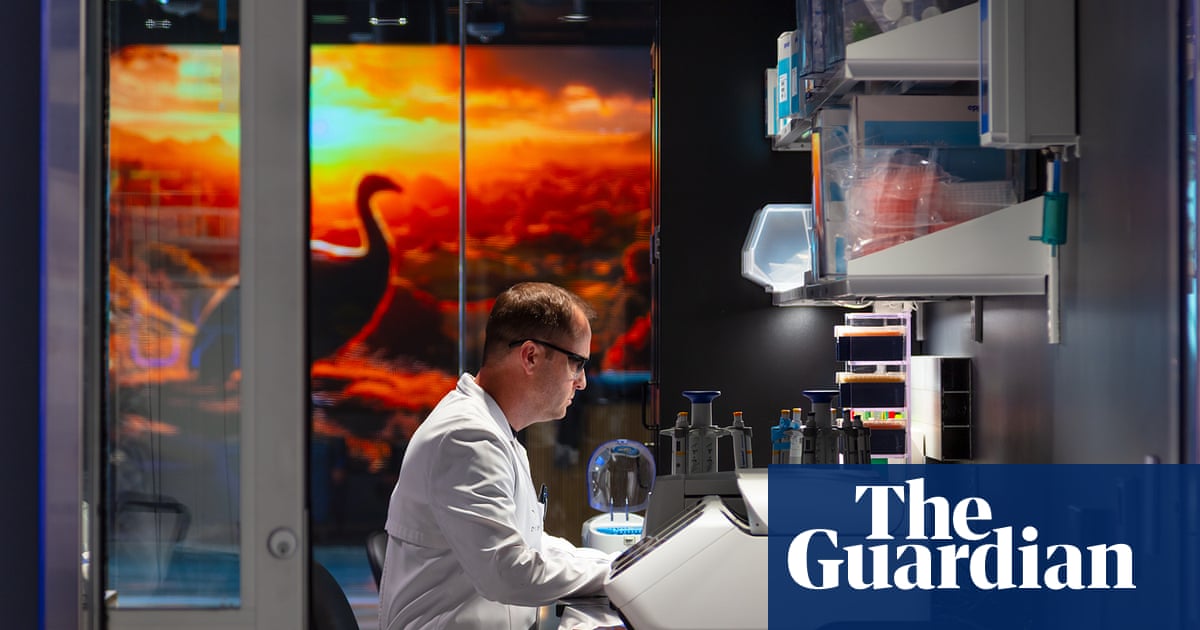
In the lab space, serried ranks of white-coated scientists work on isolating ancient DNA of extinct species and then using Crispr technology to edit the genomes of extant, closely related animals. For the dire wolves, 14 out of 19,000 gray wolf genes were edited to make the hybrid offspring snow-colored, as well as larger and more cold resistant than standard gray wolves.
Tweaking the traits of species in this way is simpler for some animals than others. Colossal is trying to resurrect the thylacine, or Tasmanian tiger, the last of which died in an Australian zoo in 1936. The closest living relative to the thylacine, which resembled a large striped dog, is the fat-tailed dunnart, which looks like a shocked mouse. While both are, in fact, marsupials, the challenge of superimposing one upon the other will probably take more than a million different gene edits and several more years of toil.
Birds are more even more difficult as they cannot be cloned from samples of skin or hair like mammals, most famously Dolly the sheep, can. Undeterred, Colossal is attempting to revive the dodo, which humans wiped out nearly 400 years ago, and the moa, a startlingly huge flightless bird, up to 12ft in height, that disappeared from New Zealand a couple of centuries prior to that.
Colossal has cultivated primordial germ cells – the embryonic precursors to sperm and eggs – from the pigeon, the closest relative to the dodo. For the moa, the nearest existing match is the emu. In a room adjoining the main lab, incubators hold pigeon and moa eggs, the latter being enormous and green, as scientists with microscopes and steady hands plunge instruments into openings in the shells.
For such innovations, Colossal has been garlanded with praise and attention (the company has festooned clippings of global press coverage across the walls of one room – one headline from the UK’s Daily Star on the dire wolf births reads “Jurassic Bark”). “The fact that we have as much support as we do is kind of crazy given what we’re doing is so polarizing,” Lamm acknowledged.
But there are scientists who doubt whether this is de-extinction at all, with some damning Colossal as an empty generator of hype and little else. “They made genetically modified gray wolves, not dire wolves – to say they are dire wolves is entirely arrogant,” said Vincent Lynch, an expert in evolutionary developmental biology at the University at Buffalo. “You can’t put a mutation into a related species and call that thing the extinct thing. You can’t bring things back in the way Colossal are doing it.”
What makes a species a species is a philosophical as well as scientific question, but Colossal’s definition is one that “hasn’t been used since Plato”, said Lynch, who has been involved in public spats with the company and has been attacked, along with fellow critics, in online articles (Colossal says it has no involvement in this).
“They say if it looks like the thing then it’s the thing, but we haven’t used that definition for a long time,” he said. “And yet they keep calling the damn thing a dire wolf. Ben Lamm is a tech bro who thinks technology can solve the world’s problems, but de-extinction isn’t going to do that.”
While it’s possible to modify a species’ appearance, the behavior of extinct animals is a more unknowable variable. The new gray wolves/dire wolves aren’t being released into the wild, but the dodos, thylacines and wooly mammoths, the latter created from gene-edited Asian elephants, will be, with the hope they will perform the same ecological functions, such as predation, seed dispersal and carbon storage, that were stripped from the environment when they became extinct.
Ecosystems are dynamic places, though, and they too evolve and adapt even as humans increasingly decimate wildlife through pollution, hunting, habitat loss and the climate crisis.
When we blunderingly introduce species to new places, such as lanternflies or the rats that helped see off the dodo, we tend to call them “invasive” and harmful. Dodos and thylacines could well slot back into their landscapes but mammoths, lost since the end of the last ice age around 10,000 years ago, would “cause an incredible amount of drama”, according to Julie Meachen, a Des Moines University paleontologist who helped crack the dire wolf genome.
“Having mammoths in Alaska or Canada near human settlements would be asking for disaster,” she said. “If they come into town will you shoot them? If they are instead held in a glorified zoo will you just sell tickets to rich people to ogle them? What would be the point? Mammoths would modify the habitat – they are a keystone species – but we don’t have a good idea how we’d coexist with them.”
We are “so far from understanding” the traits of extinct species and the complex way they altered their surroundings, according to Victoria Herridge, a paleontologist at the University of Sheffield, who added she is “shocked” that Colossal is forging ahead with using elephants as a surrogate for mammoths. (Lamm said this task is on track for 2028 following the creation of mice with mammoth-like hair, but that the utmost care will be taken with elephants: “We’re not going to inspire many kids if we kill a bunch of animals.”)
Even if gene editing does successfully reinstitute lost beasts with disputed nomenclature, Colossal’s critics fret that this could further erode endangered species protections already under attack by the Trump administration and Republicans in Congress. Why bother to do much to protect a threatened species, after all, if we can just revive it later, Lazarus-style?
“If we’re going to be in anguish about losing a species, now we have an opportunity to bring them back,” Doug Burgum, Trump’s secretary of the interior, said last year. “Pick your favorite species and call up Colossal.”
This sort of talk creates a “moral hazard” that substitutes habitat protection and hunting bans with speculative tech fixes, Lynch claimed, similar to concerns that geoengineering the planet, including dimming the sun, in response to the climate crisis could reduce pressure on polluters to stop polluting in the first place.
Lamm said Burgum’s comments were mischaracterized and that Colossal has stressed to the administration the importance of retaining habitat to avoid further extinctions, with technology aiding, rather than replacing, this process.
“(Burgum) is a huge Teddy Roosevelt guy, he’s a big conservationist and he’s very, very deep in with the Indigenous people of America,” Lamm said.
“He told us when we were with him that animals must come off the endangered species list through recovery. And his issue with the Endangered Species Act is we put animals on there and they don’t come off because we have not prioritized technologies or ways to get them off, not by removing them, but because they have recovered.”
The criticism over what to call Colossal’s species is a largely semantic argument which pales next to the prospect of losing up to 1m of the world’s species from extinction, Lamm added. “I frustrate some of those critics because if people want to call our wooly mammoths wooly mammoths, I’m happy with that,” he said.
“If they want to call them cold-tolerant Asian elephants with edited mammoth alleles across the 1.4m, here’s the genetic divergence, using Crispr, I’m fine with that too. It doesn’t affect me. Their choice of what they call an animal doesn’t affect our work, our mission.
“Look, in every aspect of life, you got A teams and B teams,” Lamm said of his critics. “Sometimes people don’t make the cut and they’re JV and they don’t make the varsity team and they’re going to be a little frustrated by that.”
Beth Shapiro, an evolutionary molecular biologist who is Colossal’s chief scientist, has had to get used to becoming a lightning rod in the scientific community – she recently had to deal with a minor verbal onslaught from another scientist at a conference – but is still baffled by the focus on species definition, rather than the functions of Colossal’s technology in conservation.
“I was surprised by some of the pushback, but if you don’t want to call them a dire wolf, that’s fine, I don’t care,” Shapiro said. Many species are on a rapid path to extinction if nothing else is done, she added, requiring thought-out but also drastic interventions.
“If you’re not controversial, you’re not pushing hard enough, right?” she said. “If we just stick with what everybody is comfortable with, then we’re just going to keep it with the status quo and we know that the status quo is not good enough.”
The splashy PR and headlines surrounding Colossal evokes thoughts of rewilded mammoths, dodos and other handpicked faunal icons churned out to turn the clock back on a damaged and denuded planet. But while this prospect has garnered attention and funding, Colossal’s true impact will likely be in the less glamorous work to stave off extinction in existing species.
Its gene editing technology could bring back genetic diversity to creatures like red wolves, which have shrunk to a population of barely two dozen, formulate a vaccine to prevent a deadly virus in Asian elephants and make quolls, a marsupial in Australia, resistant to the toxins released by invasive cane toads that have spread across the country.
“I actually think that is going to be the broader application of these technologies,” Shapiro said. Colossal “at its core is a species preservation company”, the business wrote in a submission to the International Union for Conservation of Nature last year. “Ultimately, we recognize that no project can perfectly reconstitute an extinct species or replicate past ecosystems. Instead, we interpret ‘de-extinction’ as a practical gateway to develop next-generation conservation tools.”
There is a financial upside in expanding this scope of this tech for Colossal, too – five separate spin-off companies have started or are in the works, ranging from an effort to combat plastic pollution to a startup that will work in what Lamm calls the “national security” space.
“My science brain does think, ‘Urgh, I’m not into sensationalism,’ but I understand why they have tried to inspire wonder in the general public,” said Meachen.
“The true good work Colossal is doing is injecting genetic variation into organisms that are struggling. It’s not as sexy as de-extinction, but it can keep populations viable, and that to me is more important. Genetic editing can be a tool in the toolbox, although if there are no places for these species to live then they won’t survive, even if we edit all of their genes.”
For now, though, most of the attention is still drawn to the wonder. On various large wall-mounted screens in the Colossal office, footage shows the three ‘dire wolf’ pups that were unveiled last year – two males named Romulus and Remus and one female named Khaleesi, a nod to the Game of Thrones universe that made dire wolves more widely known – frolicking in snow.
Peter Jackson, the Lord of the Rings director and another Colossal investor, is a collector of movie and TV memorabilia including “the Iron Throne”, the royal seat made of melted swords in Game of Thrones. Jackson suggested the pups be photographed on the throne, just their latest brush with fame after being presented to George RR Martin, author of the books upon which the HBO series is based.
“Handing a dire wolf puppy to George and saying, ‘This is the first dire wolf in 12,000 years’ – I mean, that’s one of those insane moments in your life where you go, ‘How the hell did I get here?’” said Matt James, Colossal’s chief animal officer.
Martin emitted some “very overemotional sort of stuttering and then said, ‘You guys brought back the dire wolf,’” James said. “It was incredible.”
